The Complete Guide to Reading the Iliad

The Complete Guide to Reading the Iliad

A structured primer for approaching Homer's epic on its own terms

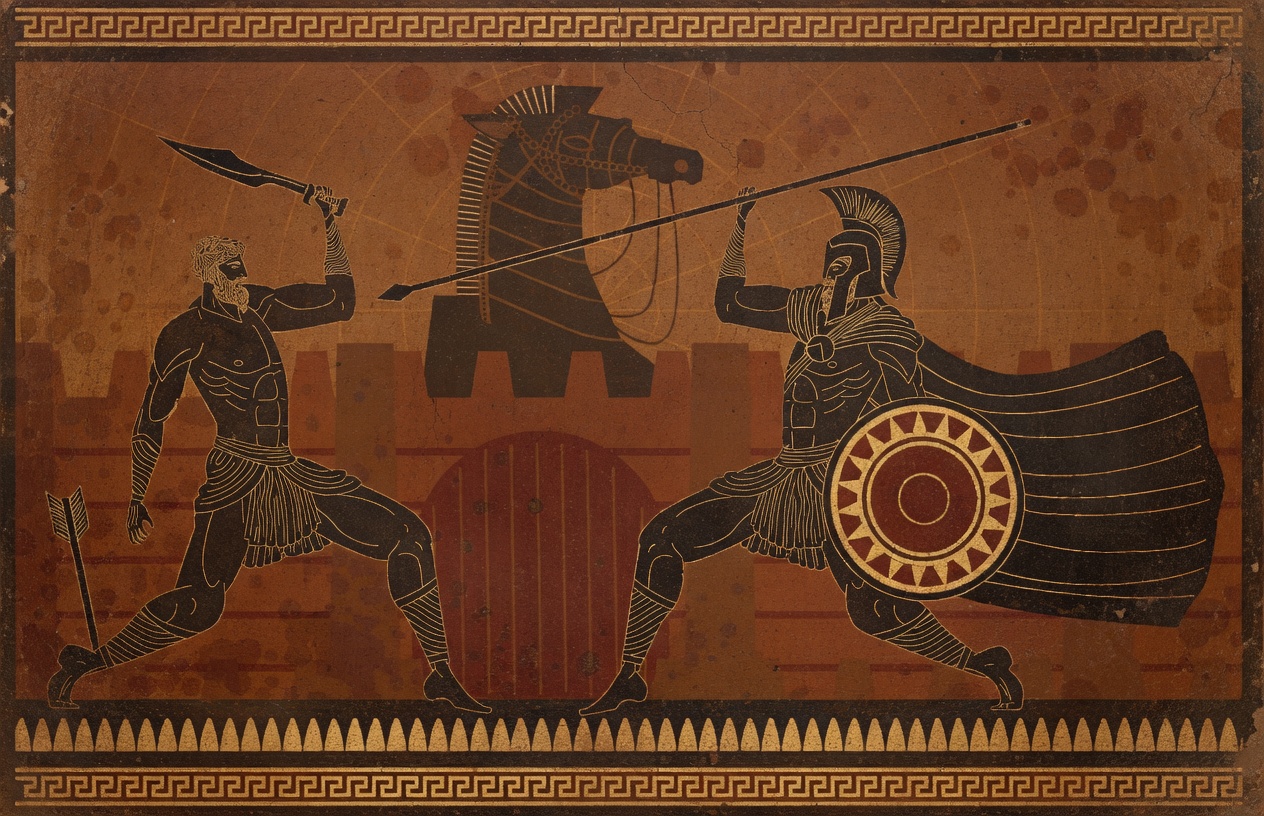
Two Greek warriors with spears, Trojan Horse in the background — red-figure pottery style
"The Iliad is the poem of force. Force as man's instrument, force as man's master, force before which human flesh shrinks back."
— Simone Weil, The Iliad, or the Poem of Force

This guide is a reading primer — a structured preparation for engaging with the Iliad on its own terms. It does not summarize or replace the poem. Its purpose is to assemble, in advance of your reading, the contextual knowledge that Homer's original audience possessed as a matter of course: the mythological background, the social world of the Bronze Age Greeks, the cast of characters, the scholarly conversation surrounding the text, and the practical choices a modern reader must make before opening the book.

The Iliad was composed for an audience that already knew everything. The Greeks who first heard these poems performed at religious festivals had absorbed the full arc of the Trojan War from childhood — the Judgment of Paris, the gathering of the fleet at Aulis, the death of Achilles, the Trojan Horse, the fall of the city. Homer assumed that knowledge entirely and built upon it. He does not introduce his characters; he presents them. He does not explain the war's causes; he plunges into a crisis ten years in. Modern readers arrive without that preparation, and the poem's opening books can feel disorienting as a result — dense with unfamiliar names, unexplained relationships, and assumed backstory. This primer addresses that gap.

The Bronze Age World

The world Homer's war destroyed

The Trojan War, if it happened at all, took place in the Bronze Age — a world of interconnected palace economies, international trade, and diplomatic correspondence that collapsed catastrophically around 1200 BC. There is something important to grasp about Homer's audience: the poems were composed and first performed by people already living in the ruins of that world. The heroes' gold and bronze, their great palaces and elaborate rituals of hospitality, their elaborate codes of honor — all of this was memory, not lived reality. The Iliad is a civilization's elegy for itself, sung in a Dark Age to listeners who knew the greatness was gone.

1177 BC — Eric Cline
1177 BC: The Year Civilization Collapsed
Eric H. Cline
The essential modern account of the Bronze Age world and its sudden end. Cline synthesizes archaeology, climate science, and ancient records to explain the interconnected catastrophe that destroyed the Mycenaean Greeks, the Hittites, and a dozen other civilizations simultaneously. Reading this first makes the Trojan War feel like something that actually happened.
Buy on Amazon →
The Trojan War — Barry Strauss
The Trojan War: A New History
Barry Strauss
Strauss bridges Homer and archaeology more directly than almost any other modern scholar. He takes the Iliad seriously as a historical source while being clear about what can and cannot be verified, drawing on Hittite records, the archaeology of Hisarlik (the probable site of Troy), and comparative military history. Readable and rigorous in equal measure.
Buy on Amazon →
A History of the Ancient Near East
A History of the Ancient Near East ca. 3000–323 BC
Marc Van De Mieroop
The standard academic survey of the ancient Near East — the broader world of empires, trade routes, and diplomacy within which the Trojan War occurred. More demanding than Cline or Strauss but invaluable for understanding the political and cultural context surrounding Bronze Age Troy. The Hittites, Egyptians, Assyrians, and Babylonians who appear in the historical record around 1200 BC all find their place here.
Buy on Amazon →

Some links on this page are affiliate links. We may earn a small commission at no extra cost to you.

Ancient Historians

How the classical world remembered and rationalized the Trojan War

Homer's contemporaries and near-successors did not treat the Trojan War as myth — they treated it as history, subject to scrutiny and debate. These ancient writers are the first in a long line of readers who tried to figure out what really happened at Troy, and how much of Homer to believe.

Theogony and Works and Days
Hesiod
The divine origin story Homer assumes you already know. Written roughly contemporary with Homer, Hesiod's Theogony lays out the genealogy of the gods — how Zeus came to power, which gods are related to which, and why the Olympians behave the way they do. A short read that pays enormous dividends when the gods start intervening in the Iliad.
Buy on Amazon →
History of the Peloponnesian War
Thucydides
Thucydides treated the Trojan War as a genuine historical event but applied skeptical scrutiny to Homer's numbers and claims. His brief analysis in Book 1 is essential: he accepts the war happened while doubting its scale. This ancient critical distance is a useful corrective to both dismissing Homer entirely and accepting him too literally.
Buy on Amazon →
The Histories
The Histories
Herodotus
Herodotus placed the Trojan War in a broader eastern Mediterranean context, seeing it as an early episode in the long conflict between Europe and Asia. His account of how the Egyptians and Phoenicians remembered the story of Helen is a fascinating counterpoint to Homer's version — a reminder that the Greeks were not the only people with opinions about what happened at Troy.
Buy on Amazon →

Some links on this page are affiliate links. We may earn a small commission at no extra cost to you.

Modern Scholars

The academics who rebuilt Homer's world from the ground up

The modern scholarly tradition on Homer is vast, but a handful of works stand above the rest — books that don't just describe the Homeric world but fundamentally change how you read the poem. These are the ones worth knowing before you start.

SPQR: A History of Ancient Rome
Mary Beard
Cambridge classicist and the most prominent public intellectual on the ancient world writing in English today. SPQR is the best modern introduction to Roman history and provides essential context for understanding the Greek world that preceded and influenced Rome. Her scholarship on ancient culture, gender, and power also informs how contemporary readers approach Homer.
Buy on Amazon →
The World of Odysseus
M.I. Finley
Foundational work on Mycenaean social history. Finley examines the economics, social structures, and value systems of the Homeric world with the rigor of a historian rather than a literary critic. Understanding xenia (guest-friendship), the honor economy, and heroic obligation before you read the Iliad transforms the poem from a battle narrative into a social drama.
Buy on Amazon →
The Best of the Achaeans
Gregory Nagy
A deep examination of heroic glory and the social function of epic poetry. Nagy argues that the Homeric poems are not simply stories but a form of cultural memory. His analysis of kleos (glory, fame) and what it meant for a hero to be remembered is essential for understanding why Achilles makes the choices he does.
Buy on Amazon →
In Search of the Trojan War
Michael Wood
Follows the archaeology from Schliemann's first excavations in the 1870s through modern work at Hisarlik. Originally a BBC documentary series, Wood's book is accessible and absorbing — a detective story about whether Troy was real, and what "real" even means in this context.
Buy on Amazon →

Some links on this page are affiliate links. We may earn a small commission at no extra cost to you.

Mythology

The divine and heroic world Homer assumes you already know

Homer wrote for an audience steeped in Greek myth from childhood. The gods, the heroes, the genealogies, the backstory of the Trojan War — none of it is explained in the poem because none of it needed to be. Modern readers arrive without that foundation. These three books build it.

Mythology — Edith Hamilton
Mythology
Edith Hamilton
The standard orientation to the Greek mythological world. Hamilton covers the creation of the gods, the major heroes, and the full Trojan cycle in clear, engaging prose that requires no prior knowledge. Read Part Four (The Trojan War) at minimum. Its limitations are real — it occasionally smooths over contradictions and reflects its era's assumptions — but as a first map of the territory it remains unmatched.
Buy on Amazon →
The Greek Myths — Robert Graves
The Greek Myths
Robert Graves
The most comprehensive single-volume treatment of Greek mythology in English. Graves retells every major myth with full source citations, variant traditions, and his own idiosyncratic interpretive commentary. The commentary is controversial among classicists — Graves had strong theories about matriarchal origins that color his readings — but the retellings themselves are vivid and authoritative. An invaluable reference to return to during and after your reading of the Iliad.
Buy on Amazon →
The Library — Apollodorus
The Library (Bibliotheca)
Apollodorus, trans. Robin Hard
The mythological reference book of the ancient world — a comprehensive summary of Greek myth from the creation to the Trojan War and its aftermath, written by an ancient compiler who had access to sources now lost. Not a book to read cover to cover, but invaluable as a reference when the Iliad mentions a character or event whose backstory you do not know. The Robin Hard translation is recommended for its clarity and useful notes.
Buy on Amazon →

Some links on this page are affiliate links. We may earn a small commission at no extra cost to you.

After the Iliad

The ancient works that extend and respond to Homer's poem

The Iliad did not end a conversation — it started one. The ancient works below are the most essential responses: Homer's companion epic, the Roman reimaginings, and the Latin poets who argued with, extended, and rewrote Homer across the centuries.

The Odyssey — Homer
The Odyssey
Homer
The companion epic — Homer's own sequel, in spirit if not in strict chronology. Where the Iliad is about the cost of glory, the Odyssey is about the cost of survival. Read it after the Iliad and the contrast is devastating: Achilles chose death and eternal fame; Odysseus chose life and got twenty years of suffering trying to get home. The two poems together form a complete argument about what it means to be a hero.
Buy on Amazon →
The Aeneid — Virgil
The Aeneid
Virgil
The Roman response to Homer — and a deliberate rewriting of it. Read Book 2 immediately after finishing the Iliad: Aeneas narrates the fall of Troy with devastating force, giving you the ending Homer withholds. But the Aeneid is more than a sequel — Virgil uses Homer's framework to ask whether Roman imperial power is worth the human cost. The Fagles translation is recommended.
Buy on Amazon →
Metamorphoses — Ovid
Metamorphoses (Books 12–13)
Ovid
Ovid retells the Trojan War in Books 12 and 13 with characteristic wit and compression — and with a deliberate, ironic distance from Homer's heroic values. Book 13 contains the debate between Ajax and Odysseus over Achilles' armor, one of the most brilliant rhetorical set pieces in Latin literature. Ovid is consciously rewriting Homer, and he wants you to notice. The Charles Martin translation is excellent.
Buy on Amazon →
Heroides — Ovid
Heroides
Ovid
Letters written in the voices of mythological women — including Briseis writing to Achilles from Agamemnon's tent. The Briseis letter is extraordinary: it gives the Iliad's most conspicuously silent character a complete interior life, and in doing so reframes the entire poem from her perspective. Anyone interested in the women Homer marginalizes should read this alongside Haynes.
Buy on Amazon →
Achilleid — Statius
Achilleid
Statius
An unfinished 1st century AD epic about Achilles' childhood — the years before the Iliad begins. Statius covers the hero's upbringing by the centaur Chiron, his disguise as a girl on the island of Scyros, and his discovery by Odysseus. The ancient world's prequel to Homer, and a surprisingly tender portrait of the hero before the rage. Less well known than it deserves to be.
Buy on Amazon →

Modern Retellings

Contemporary novels that bring Homer's characters to life

These modern novels do something ancient scholarship cannot — they make you care about Achilles, Patroclus, and the women of Troy before Homer's poem begins. A note of honest framing: these are modern reinterpretations that apply contemporary sensibilities to ancient material. Read them to build emotional investment, then let Homer's harsher heroic world surprise you.

The Song of Achilles
Madeline Miller
The best entry point for emotional investment in the characters. Miller tells the story of Achilles and Patroclus from Patroclus's perspective, from childhood through Troy, with warmth and psychological depth that makes both characters feel fully human. Readers who come to the Iliad after this novel find that Patroclus's death in Book 16 hits with an entirely different force. A note of honest framing: this is a modern reinterpretation — Miller prioritizes psychological interiority and romantic feeling in ways Homer does not. Read it to care about the characters, then let Homer's harsher heroic code surprise you.
Buy on Amazon →
Circe — Madeline Miller
Circe
Madeline Miller
Miller's second novel follows the witch Circe — daughter of the sun god Helios, minor figure in the Odyssey — across millennia of Greek myth. Where Song of Achilles is about glory and loss, Circe is about power and transformation. It touches the Trojan War world obliquely but rewards readers who have already met its cast of characters. The best of Miller's work by many readers' estimation.
Buy on Amazon →
A Thousand Ships
A Thousand Ships
Natalie Haynes
The Trojan War from the perspectives Homer marginalizes — the women, the Trojans, the figures who appear briefly and are then forgotten. Haynes gives voices to Penelope, Hecuba, Cassandra, and Briseis, filling in the human reality around Homer's male-centered narrative. An excellent complement to the Iliad rather than a substitute for it. Like Miller, Haynes draws on the full Epic Cycle and applies a distinctly contemporary critical lens to the ancient material.
Buy on Amazon →

Some links on this page are affiliate links. We may earn a small commission at no extra cost to you.

Choosing Your Translation

The four translations that matter, and which is right for you

Every translation of the Iliad is also an interpretation. The Greek is ancient, dense, and musical in ways that cannot be fully replicated in English, so every translator makes choices that shape your experience of the poem. The four translations below represent the serious options for English-language readers.

The Iliad — Fagles translation
The Iliad — trans. Robert Fagles (1990)
Flowing, accessible, most widely recommended
The most widely recommended translation for general readers. Fagles finds a middle path between strict fidelity to the Greek and natural English readability — his version flows well, reads quickly, and carries genuine poetic force. The introduction by Bernard Knox is itself essential Homeric scholarship. Choose this for your first read.
Buy on Amazon →
The Iliad — Emily Wilson translation
The Iliad — trans. Emily Wilson (2023)
Most modern, very clear
The most modern translation, praised for its clarity and attention to the poem's emotional register. Wilson's version is clean, direct, and contemporary without being anachronistic. The best choice for readers who found older translations stilted. Also notable for its feminist critical perspective in the introduction.
Buy on Amazon →
The Iliad — Peter Green translation
The Iliad — trans. Peter Green (2015)
Scholarly depth, outstanding notes
The most recent major scholarly translation. Green brings both classical expertise and literary sensibility — his version is accurate without being stiff, and his extensive footnotes illuminate what Homer is doing at the technical level. The best choice for a second read or for anyone approaching the poem seriously as a student of the ancient world.
Buy on Amazon →
The Iliad — Lattimore translation
The Iliad — trans. Richmond Lattimore (1951)
Closest to the Greek, most demanding
The closest to the Greek and most respected among scholars. Lattimore preserves the formulaic repetitions and long rolling hexameter lines that give Homer his distinctive rhythm — but this makes it slower and harder going for first-time readers. Return to Lattimore after a first read with Fagles or Wilson.
Buy on Amazon →

Some links on this page are affiliate links. We may earn a small commission at no extra cost to you.

Podcasts to Accompany Your Reading

Audio companions for the commute, the gym, or the long read

Some of the best Homeric scholarship and storytelling right now is happening in podcast form. These are sequenced from most immediately relevant to deeper cuts — start at the top and work down as your interest grows.

The Rest is History — Episode 13: Troy
Tom Holland & Dominic Sandbrook, with Stephen Fry
Start here. Stephen Fry joins Holland and Sandbrook for a wide-ranging conversation on Homer, myth, archaeology, and why the story of Troy has never stopped mattering. Episode 13 is the essential entry point, but the back catalogue has dozens of relevant episodes on the Bronze Age, Greek culture, and the ancient Mediterranean. Holland is also a classicist and the author of Rubicon and Dynasty. Available on all major podcast platforms.
Natalie Haynes Stands Up for the Classics
Natalie Haynes — BBC Radio 4
The Iliad episode and the Odyssey episode are the two to start with — search "Natalie Haynes Iliad" on BBC Sounds and it comes up immediately. Each episode focuses on a single classical text or figure and makes the material feel immediate and alive. One of the best introductions to classical literature available in any format. Free on BBC Sounds.
Instant Classics
Mary Beard
Mary Beard — Cambridge classicist and SPQR author — brings ancient texts to contemporary audiences with characteristic candor and rigor. Particularly useful for the episodes on Greek literature, women in antiquity, and the reception of classical culture. A good follow-on once you have finished Haynes.
The Ancients
History Hit
Broader coverage of the ancient Mediterranean world, with episodes on Bronze Age archaeology, Homeric scholarship, Troy, and Greek culture. A good supplement when you want more depth on a specific topic — Bronze Age trade, Mycenaean warfare, the Sea Peoples. Search by topic rather than listening sequentially.
The History of Rome
Mike Duncan
The foundational history podcast — 179 episodes covering the full arc of Roman history from founding to fall. Not directly about Homer, but essential context for the Roman works in the After the Iliad section. Begin at episode 1. Duncan's series set the template for narrative history podcasting and remains one of the best ever made.
Alessandro Barbero Lectures
Alessandro Barbero — YouTube
An Italian-language option for the adventurous reader. Barbero is one of Europe's most beloved historians — a specialist at the University of Turin whose lectures on the ancient warrior ethos are available on YouTube. His extraordinary gift for inhabiting the minds of people from the distant past makes him essential listening for anyone reading the Iliad's battle scenes. His energy and narrative clarity translate even across the language barrier.

How to Read the Iliad

Practical advice for once the book is open

Preparation gets you to the door. These are the habits that determine what happens once you step inside.

Read Aloud

The Iliad was composed to be performed, not read silently. Even moving your lips slightly as you read changes the experience — the rhythm of the hexameter becomes audible, the epithets stop feeling repetitive and start feeling like a drumbeat, and the speeches gain their full rhetorical weight. If you find yourself reading passages twice because nothing is sticking, try reading them aloud once instead.

Keep the Character Reference Open for the First Three Books

Books 1 through 3 introduce more named characters than any other section of the poem. Do not try to hold them all in your head — consult the Character Reference freely. By Book 4 the major figures have established themselves and the catalogue of minor names becomes less disorienting. The goal of the first three books is to meet Achilles, Agamemnon, Hector, and the gods — everything else is texture.

Mark Every Simile

Homer's similes are the poem's emotional thermostat. When the battle is at its most brutal and abstract — spears flying, bodies falling, blood and dust — Homer reaches for a simile drawn from the natural world: bees swarming, snow falling, a lion pulling down a deer. These are not decorations. They are the poet's way of controlling how much horror you feel at any given moment, and they are among the most technically accomplished things in the poem. A reader who tracks the similes is reading the Iliad the way it was designed to be read.

Notice When the Poet Speaks Directly to You

Homer occasionally steps outside the story and addresses a character — or the reader — directly. The most famous example is his address to Patroclus in Book 16: "Then you, Patroclus, called out to your horses..." This shift from third person to second person is not an accident. It signals that what is about to happen carries unusual emotional weight, and it creates an intimacy between poet and reader that is unlike anything in later literature. When you encounter it, stop and notice it.

Do Not Skip the Catalogue of Ships

Book 2's Catalogue of Ships — the long list of every Greek contingent and their commanders — is the section most readers skip or skim. Resist the temptation, at least on a first read. The Catalogue establishes the political geography of the Greek world and gives you a sense of the scale of the expedition. It is tedious precisely because it is meant to feel massive. Having endured it, the rest of the poem feels proportionate.

The Poem Does Not End Where You Expect

The Iliad does not end with the fall of Troy, the Trojan Horse, or the death of Achilles. It ends with Hector's funeral. Homer makes a deliberate choice to close on an act of grief and dignity rather than victory or spectacle — and understanding why he makes that choice is one of the deepest rewards the poem offers. If you finish the poem wondering what happens next, the Aeneid and the Odyssey are waiting.

Character Reference

The major figures of the Iliad — who they are and what happens to them

Use this table while reading. Name spellings vary between translations — Achilles may appear as Akhilleus (Lattimore), Aias as Ajax, Patroklos as Patroclus. They are the same people.

Greeks (Achaeans)
NameWho They AreFate
AchillesGreatest Greek warrior. Son of the sea-nymph Thetis and mortal Peleus. His rage at Agamemnon drives the entire poem. Knows he will die young at Troy but chooses glory over a long life.Dies after the Iliad ends — killed by Paris's arrow, guided by Apollo. This occurs in the Aethiopis, part of the Epic Cycle, not in the Iliad itself.
AgamemnonCommander-in-chief of the Greek forces. King of Mycenae. Arrogant, politically necessary, and fatally shortsighted. His seizure of Briseis from Achilles in Book 1 is the act that unravels everything.Returns home after Troy to be murdered by his wife Clytemnestra and her lover Aegisthus.
PatroclusAchilles' closest companion — gentle, beloved, and reckless. His death in Book 16 is the poem's great turning point, the event that returns Achilles to the war with catastrophic force.Killed by Hector in Book 16, having been stopped at Troy's walls by Apollo and pushed too far past his limits.
OdysseusKing of Ithaca. The cleverest Greek — diplomat, strategist, and pragmatist. He leads the embassy to Achilles in Book 9 and the night raid in Book 10. Hero of his own epic, the Odyssey.Survives Troy; wanders for ten years before reaching home.
Ajax (Great)Massive, implacable warrior — the second-best fighter after Achilles, and the one with no divine patron to protect him. He holds the line when others falter.Dies after the Iliad — by suicide, after losing the contest for Achilles' armor to Odysseus.
DiomedesKing of Argos. Ferocious fighter and the standout hero of Books 5–6. The only mortal in the poem to wound gods in battle — he wounds both Aphrodite and Ares in Book 5.Returns home safely — one of the few Greek commanders to do so without disaster.
NestorAged king of Pylos. The Greeks' wise counselor, known for long and tactful reminiscences of his own past glories. His advice is usually sound; his timing is sometimes exasperating.Survives; returns home to Pylos.
MenelausKing of Sparta, Helen's husband, and the wronged party whose stolen wife is the war's nominal cause. Decent, brave, and consistently outclassed by the warriors around him.Survives; reunites with Helen and returns to Sparta.
PhoenixAchilles' old tutor and father-figure. Part of the embassy to Achilles in Book 9. His long speech about the power of prayer and the danger of stubbornness falls on deaf ears.Remains with Achilles throughout the poem.
TeucerAjax's half-brother. The best archer among the Greeks, who fights from behind Ajax's enormous shield.Survives Troy.
Trojans & Allies
NameWho They AreFate
HectorTroy's greatest defender. Son of Priam, husband of Andromache, father of Astyanax. He fights not for glory but for his city and family. The most fully human figure in the poem.Killed by Achilles in Book 22. His body is dragged behind Achilles' chariot and ransomed back to Priam in Book 24.
PriamAged king of Troy. Father of fifty sons, including Hector and Paris. Dignified in catastrophe. His journey to Achilles' tent in Book 24 is one of the great moments in all literature.Survives the Iliad; killed by Achilles' son Neoptolemus when Troy falls.
ParisTrojan prince whose theft of Helen from Menelaus's household caused the war — a violation of xenia that obligates the gods. Handsome, cowardly, and protected by Aphrodite.Kills Achilles with an arrow after the Iliad ends, guided by Apollo. This occurs in the Aethiopis, not the Iliad.
AndromacheHector's wife. Her farewell scene with Hector in Book 6 — she begs him to stay; he cannot — is among the most affecting passages in the poem.Enslaved when Troy falls. Her infant son Astyanax is thrown from the walls.
AeneasTrojan warrior, son of Aphrodite and a mortal prince. Repeatedly rescued from certain death by gods. Destined to survive Troy and found the lineage that will lead to Rome — a fate the gods protect.Escapes Troy. Becomes the hero of Virgil's Aeneid.
HecubaQueen of Troy, Priam's wife, mother of Hector and Paris. Watches everything — her husband's journey to Achilles, her son's death, the fall of her city.Enslaved when Troy falls.
HelenThe cause and captive of the war. In the Iliad she is melancholy and self-aware, not triumphant. She watches the battle from Troy's walls in Book 3 with Priam, naming the Greek warriors below.Returns to Sparta with Menelaus after Troy falls.
SarpedonKing of Lycia and ally of Troy. Son of Zeus himself. One of the poem's finest warriors and its clearest spokesman for the heroic code — his speech to Glaucus in Book 12 is the poem's great statement of why heroes fight.Killed by Patroclus in Book 16. Zeus cannot save him; it is his fated hour.
GlaucusLycian ally and companion of Sarpedon. Famous for Book 6's xenia scene, where he and Diomedes discover their grandfathers were guest-friends and exchange armor instead of fighting.Survives most of the Iliad; dies after the poem ends.
PolydamasTrojan nobleman and Hector's closest advisor. Born the same night as Hector. His counsel is consistently wise; Hector consistently ignores it. The voice of reason in an army that cannot afford reason.Survives the Iliad.

Battle & Geography Reference

The physical world of the Iliad — locations, landmarks, and the mechanics of Homeric warfare

The Iliad takes place in a confined geography — a stretch of coastline, a plain, a city on a hill — but that geography is used with precision. Knowing where things are makes the battle scenes and tactical movements considerably easier to follow.

Key Locations
LocationWhat It Is & Why It Matters
Troy (Ilion)The walled city on the hill. The Trojans fight from behind its walls and in sorties onto the plain below. Never actually falls within the Iliad's timeframe — the poem ends before the city's destruction.
The Scaean GatesThe main western gate of Troy, facing the Greek plain. The primary exit point for Trojan armies. Hector says farewell to Andromache here in Book 6. Achilles dies near these gates after the poem ends.
The Plain of TroyThe flat ground between the city walls and the Greek camp on the shore. The stage for virtually every major battle in the poem. The Scamander and Simois rivers cross it.
The Greek CampA fortified beachhead on the Hellespont shore, roughly a mile from Troy. Ships pulled onto the beach; huts and a defensive wall behind them. Achilles' tent is at one end; Ajax's at the other. The camp is nearly burned in Books 15–16.
The River ScamanderThe main river running across the Trojan plain. Called Xanthos by the gods. Site of one of the poem's strangest episodes — the river god himself rises against Achilles in Book 21, furious at the corpses clogging his waters.
The River SimoisThe second river of the plain, flowing parallel to the Scamander. Often paired with it in descriptions of the battlefield. Less prominent but provides the geographical boundary of the fighting.
The Greek WallA defensive fortification the Greeks build around their camp in Book 7. The Trojans breach it in Book 12 — Hector smashes the gate with a boulder. Its construction and fall mark the poem's turning point.
Mount IdaThe mountain range behind Troy, southeast of the city. Zeus watches the battle from its peak. Site of the Judgment of Paris in the earlier mythology that precedes the poem.
Mount OlympusHome of the gods — located in northern Greece, far from Troy, but the gods travel instantly. The divine scenes that counterpoint the human carnage take place here.
The HellespontThe narrow strait separating Europe from Asia (modern Dardanelles). The Greek fleet is beached on its western shore. The strategic geography that made Troy important — it controlled access between the Aegean and the Black Sea.
Battle Mechanics
TermWhat It Means
AristeiaA hero's extended moment of battlefield supremacy — a sustained sequence in which one warrior dominates. Each major hero gets at least one. Diomedes' aristeia in Book 5 is the first and most spectacular; Patroclus's in Book 16 is the most consequential.
PromachoiThe front-line champions who fight individual combats in front of their armies. Homeric battle is not a mass melee but a series of named duels between heroes, watched by the rank and file.
Stripping ArmorWhen a hero kills an opponent, he attempts to strip the body of its armor — both for its material value and as a demonstration of victory. Much of the fighting in the later books is over possession of corpses.
ChariotsUsed primarily for transport and dramatic entries onto the battlefield, not mass cavalry charges. Heroes ride chariots to the front line, dismount to fight, then retreat by chariot when wounded.
SupplicationBegging for mercy on the battlefield — a warrior throws down his weapons, grasps the knees of his enemy, and appeals to his honor. It is rarely granted in the Iliad's brutal later books. Achilles' refusal to grant supplication is one of his defining characteristics.
Divine RescueGods routinely snatch their favorites from certain death, wrapping them in mist or teleporting them from the battlefield. Paris in Book 3, Aeneas multiple times. This is not considered cheating — it is fate operating through divine agents.
Spoils / GerasThe tangible prizes — armor, captives, tripods — that represent a warrior's timē (honor). Agamemnon's seizure of Briseis (Achilles' geras) is the theft of honor that drives the poem's plot.

Book-by-Book Synopsis

A one-line summary of all 24 books — use this to orient yourself while reading

The Iliad is divided into 24 books, a division made by Alexandrian scholars in the 3rd century BC. Each book averages around 600 lines. This synopsis is designed to be consulted while reading — a quick orientation when you lose the thread or want to know what's coming.

BookWhat HappensWhy It Matters
Book 1Agamemnon seizes Achilles' prize Briseis. Achilles withdraws from battle and asks his mother Thetis to petition Zeus to punish the Greeks.The entire poem flows from this dispute. Read it not as a personal quarrel but as a legal and economic crisis: Agamemnon has violated the honor economy that governs heroic society, publicly stripping Achilles of the physical marker of his worth. Achilles' rage is a principled response to a serious social transgression, not wounded vanity.
Book 2Zeus sends a false dream to Agamemnon. The famous Catalogue of Ships lists every Greek contingent and their commanders.The Catalogue is tedious on first read but invaluable as reference — it establishes the political geography of the Greek world.
Book 3Paris and Menelaus agree to settle the war by single combat. Paris loses and is rescued by Aphrodite. Helen watches from the walls with Priam.The "teichoscopy" (wall scene) introduces the major players. Shows how easily the war could have ended — and didn't.
Book 4The truce breaks down. The Trojans wound Menelaus with an arrow. Full-scale battle resumes.Establishes that the gods — specifically Hera — will not allow an easy resolution.
Book 5Diomedes' aristeia. He wounds Aphrodite and then Ares — the only mortal in the poem to wound Olympian gods.The most spectacular individual battle sequence in the poem. Shows what human excellence at its peak can achieve.
Book 6Hector returns to Troy. His farewell to Andromache and their son Astyanax at the Scaean Gates.The emotional heart of the poem's first half. The most purely human scene in the Iliad.
Book 7Hector and Ajax fight to a draw. Both sides agree to a truce to bury their dead. The Greeks build a defensive wall.A pause in the fighting. The wall the Greeks build will nearly fall in Books 12–15.
Book 8Zeus forbids the gods from intervening. The Trojans push the Greeks back to their wall for the first time.The tide turns. Zeus begins fulfilling his promise to Thetis.
Book 9The Greek embassy to Achilles — Odysseus, Ajax, and Phoenix beg him to return. He refuses all offers.One of the great scenes in ancient literature. Achilles' refusal is philosophically extraordinary — he is rejecting the entire heroic value system.
Book 10Odysseus and Diomedes make a night raid on the Trojan camp, killing the Thracian king Rhesus.Often considered a later addition; tonally different from the rest of the poem. Can be read quickly.
Book 11Agamemnon's aristeia. The major Greek commanders are all wounded. Patroclus is sent to get information about casualties.Sets up Patroclus's eventual intervention. The Greeks are running out of leaders.
Book 12The Trojans breach the Greek wall. Hector smashes the gate with a boulder.The Greek defensive perimeter — their last protection before the ships — is broken.
Book 13Poseidon secretly helps the Greeks while Zeus is distracted. Heavy fighting at the ships.The gods' divided loyalties in action. A complex multi-front battle difficult to follow on first read.
Book 14Hera seduces Zeus to distract him, allowing Poseidon to turn the tide back toward the Greeks.One of the poem's most darkly comic episodes — the "Deception of Zeus." Divine politics at their most operatic.
Book 15Zeus wakes up furious. He reasserts control, drives Poseidon off, and the Trojans push to the ships again.Crisis point. The Greek ships are almost burning. Patroclus can no longer stay out.
Book 16Patroclus borrows Achilles' armor and enters battle. He saves the ships, kills Sarpedon (Zeus's son), and pushes to the walls of Troy — where Apollo stops him and Hector kills him.The pivot of the entire poem. Everything before leads to this; everything after flows from it.
Book 17Extended fighting over Patroclus's body. Neither side can take it.Establishes the stakes of what has been lost. The body becomes a symbol of honor itself.
Book 18Achilles learns of Patroclus's death. His grief is devastating. Thetis visits Hephaestus to forge new armor. The Shield of Achilles is described in the poem's greatest extended passage.The Shield of Achilles — a description of an entire world engraved in metal — is one of the most analyzed passages in all of ancient literature.
Book 19Achilles and Agamemnon are formally reconciled. Achilles returns to battle, grief transformed into killing rage.The reconciliation the poem has been building toward — but it brings no relief, only more death.
Book 20Zeus lifts his ban on divine intervention. The gods enter battle on both sides. Achilles hunts Trojans.The gods' battle is almost comic; Achilles' rage is terrifying. Two registers simultaneously.
Book 21Achilles fills the river Scamander with Trojan corpses. The river god rises against him in fury. Hephaestus drives the river back with fire.The strangest episode in the poem — elemental, mythological, surreal. Nature itself rebels against Achilles' violence.
Book 22Hector stands alone outside Troy to face Achilles. He runs, is tricked by Athena, and dies. Achilles drags his body behind his chariot.The climax. Hector's death is inevitable — and Homer makes us feel every step toward it.
Book 23The funeral games for Patroclus — chariot racing, wrestling, archery, and other contests among the Greeks.A temporary release of tension. The games allow the Greeks — and the reader — to breathe before the final book.
Book 24Priam, guided by Hermes, travels alone at night to Achilles' tent to ransom Hector's body. Achilles weeps with him. The book ends with Hector's funeral.The resolution. One of the greatest scenes in all literature. The poem ends not with triumph but with grief — shared across the line of enmity.

The Gods

The Olympians in the Iliad — their sides, domains, and key interventions

The gods of the Iliad are not remote or transcendent — they are passionate, petty, and deeply invested in the war's outcome. Their interventions are constant and consequential. This table tracks who supports whom and what each god does in the poem.

The Olympians — Sides and Domains
GodSideDomainKey Role in the Iliad
Zeus Neutral / Arbiter King of gods, sky, thunder, fate Attempts to balance the war while honoring his promise to Thetis to punish the Greeks. Cannot override fate even for his own son Sarpedon (Book 16). Seduced by Hera in Book 14 to distract him.
Hera Pro-Greek Queen of gods, marriage, women Fiercely pro-Greek, still furious over the Judgment of Paris. Seduces Zeus in Book 14 to distract him while Poseidon helps the Greeks. One of the poem's most active divine schemers.
Athena Pro-Greek Wisdom, warfare, crafts Actively intervenes in battle — restrains Achilles in Book 1, assists Diomedes in Book 5, deceives Hector in Book 22. The most hands-on divine ally the Greeks have.
Poseidon Pro-Greek Sea, earthquakes, horses Secretly helps the Greeks against Zeus's prohibition in Books 13–14. Driven off by Zeus in Book 15 but not before turning the tide.
Hermes Neutral / Messenger Messages, travelers, the dead Guides Priam safely to Achilles' tent in Book 24. The gentlest divine presence in the poem.
Hephaestus Pro-Greek Fire, metalworking, crafts Forges Achilles' new armor in Book 18 at Thetis's request. Drives the river Scamander back with fire in Book 21.
Apollo Pro-Trojan Sun, prophecy, archery, plague Sends the plague on the Greeks in Book 1. Protects Hector repeatedly. Stops Patroclus at Troy's walls in Book 16. Guides Paris's fatal arrow after the poem ends.
Aphrodite Pro-Trojan Love, beauty, desire Protects Paris throughout. Rescued him from Menelaus in Book 3. Wounded by Diomedes in Book 5 — one of the poem's most striking moments. Her favoritism toward Paris is a constant Trojan liability.
Ares Pro-Trojan War, bloodshed Fights for the Trojans in several books. Wounded by Diomedes in Book 5 with Athena's help — he screams like ten thousand soldiers and retreats to Olympus. Not respected even by Zeus.
Thetis Pro-Greek (Achilles) Sea-nymph, not an Olympian Achilles' divine mother. Petitions Zeus on his behalf in Book 1 — her favor is the mechanism that drives Zeus's pro-Trojan stance. Commissions Achilles' new armor in Book 18.
The Divine Politics in Plain Terms

The war in heaven mirrors the war on earth — Hera and Athena support the Greeks because they lost the Judgment of Paris; Aphrodite and Apollo support the Trojans because Paris awarded Aphrodite the golden apple. Zeus tries to remain above the fray but is compromised by his promise to Thetis. The result is a divine stalemate that prolongs the human war. Fate — moira — operates above all of them; even Zeus cannot save his own son when Sarpedon's hour comes.

Key Terms Glossary

The Greek concepts Homer's world runs on — briefly defined

These are the untranslatable concepts that underlie the poem's logic. Modern translations render them with English approximations — "honor," "fate," "glory" — but those approximations lose precision. Knowing the original terms and their full weight makes Homer's moral world considerably clearer.

TermGreekMeaning & Significance
Menis μῆνις The first word of the Iliad: "wrath" or "rage." But not ordinary anger — menis is a special, divine-grade fury, the kind that has cosmic consequences. Only gods and the greatest heroes experience it. Achilles' menis is the engine of the entire poem.
Timē τιμή "Honor" or "worth." The social currency of the heroic world — the recognition a warrior receives from his peers and community for his excellence in battle. Agamemnon's seizure of Briseis is a theft of timē, not just a woman. This is why Achilles' response is so extreme: his very identity has been publicly negated.
Kleos κλέος "Glory" or "fame" — specifically the fame that outlives you, preserved in poetry and song. Kleos aphthiton means "imperishable glory." Achilles explicitly chooses kleos over a long life. The Iliad itself is the medium through which that kleos is preserved — the poem is performing what it describes.
Aretē ἀρετή "Excellence" or "virtue" — but in the Homeric context, primarily martial excellence. The best warrior has the most aretē. The concept later broadens in Greek philosophy (especially Aristotle) to include moral and intellectual excellence, but in Homer it is fundamentally about competitive superiority.
Aristeia ἀριστεία A hero's sustained moment of battlefield supremacy — his extended "finest hour." The Iliad is structured around a series of aristeiai: Diomedes in Book 5, Agamemnon in Book 11, Patroclus in Book 16, Achilles in Books 20–22. Each aristeia follows a recognizable pattern of buildup, climax, and aftermath.
Moira μοῖρα "Fate" or "one's allotted portion." Each person has a moira — a share of life and death assigned before birth. Even Zeus cannot override moira, as he acknowledges when his son Sarpedon is fated to die. The tension between fate and free will — do heroes choose their deaths, or merely enact what was predetermined? — is one of the poem's deepest unresolved questions.
Xenia ξενία "Guest-friendship" — the sacred obligation of hospitality between host and guest, protected by Zeus Xenios. Paris's violation of xenia by taking Helen from Menelaus's household is the moral foundation of the Greek cause. The concept explains why the war is not merely political but religiously obligatory. It also creates extraordinary moments — enemies who discover they are bound by inherited xenia agreements, and exchange gifts rather than fight (Book 6, Glaucus and Diomedes).
Hubris ὕβρις Overreach — acting beyond one's proper limits, usually by violating the honor or boundaries of another. Often translated "pride" but more precisely an act of transgression than a state of mind. Agamemnon commits hubris against Achilles in Book 1. Patroclus commits hubris by pressing past the limit Apollo sets for him in Book 16. Hubris in Homer typically triggers immediate divine punishment.
Nostos νόστος "Homecoming." The successful return from Troy — or the failure to achieve it — is the subject of the epic tradition following the Iliad. Odysseus's nostos takes ten years (the Odyssey). Agamemnon's nostos ends in murder. Achilles, of course, has no nostos — he dies at Troy. The word carries the full weight of what the war has cost.
Nemesis νέμεσις "Righteous indignation" — the anger felt (by gods, heroes, or the community) at a violation of proper order. Related to but distinct from revenge. When Achilles desecrates Hector's body, the gods feel nemesis — a sense that the proper limits of human conduct have been transgressed, which eventually compels them to intervene in Book 24.

Bronze Age Collapse Timeline

Troy was not an isolated event — it was part of a global catastrophe

The Trojan War, if it happened at all, took place inside one of the most dramatic civilizational collapses in recorded history. Within a single generation around 1200 BC, every major Bronze Age power fell. Understanding this context transforms Homer's heroes from mythological figures into inhabitants of a real, doomed world — and the poem itself into a civilization's elegy for a greatness it could no longer touch.

DateEventDescription
~1300–1200 BC Height of Bronze Age Palace Culture The Mycenaean Greeks, the Hittite Empire, Egypt under Ramesses II, and the great trading cities of Syria and the Levant form an interconnected world of diplomacy, commerce, and correspondence. This is the world Homer's heroes inhabit — one of gold, bronze, and elaborate social obligation.
~1250 BC Destruction of Troy VIIa The archaeological layer now identified as the probable historical Troy shows signs of destruction and violent conflict. This is the city the Trojan War legend remembers. Archaeologists broadly accept that a real conflict occurred here around this time, though Homer's account is heavily mythologized.
~1200 BC Collapse of Mycenaean Greece The great citadels of Mycenae, Tiryns, Pylos, and Thebes are burned or abandoned. The Linear B writing system disappears — Greece enters a Dark Age without literacy for roughly 400 years. The world the heroes fought over is gone within a generation of the war.
~1200 BC Fall of the Hittite Empire The other great superpower of the Bronze Age — contemporary with Mycenaean Greece and fully present in the records around Troy — vanishes completely. Their capital Hattusa is destroyed and abandoned. No successor state emerges. An entire civilization disappears from history.
~1185 BC Destruction of Ugarit The great Syrian trading port is destroyed and never rebuilt. A clay tablet found in the ruins contains a desperate appeal for military assistance — sent too late, never answered. Ugarit is among the best-documented casualties of the collapse, its archive preserved by the fire that destroyed it.
~1177 BC Egypt Repels the Sea Peoples Egypt faces a massive invasion by the "Sea Peoples" — a confederation of seaborne raiders whose origins remain one of the most debated questions in ancient history. Whether they were refugees from the collapsing Aegean world, opportunistic raiders, or climate-driven migrants is still contested. Egypt survives but is permanently weakened.
~1100 BC End of the Bronze Age The interconnected world of palaces, trade routes, and diplomatic correspondence is gone. The Greeks who later heard Homer's poems performed at religious festivals were listening to stories from a lost civilization — one as remote from them as the medieval is from us. The poem is an elegy for a world the poet could only imagine.

Eric Cline's 1177 BC: The Year Civilization Collapsed is the essential modern account of this catastrophe — accessible, rigorous, and genuinely gripping. Reading it alongside or after the Iliad gives the poem a different resonance entirely. The heroes' obsession with glory and immortal fame takes on new weight when you understand that the world they fought over would be rubble within a generation.

Major Battles

The key engagements of the Iliad — what happens, who is involved, and why it matters

The Iliad covers roughly four days of fighting across its twenty-four books, but those four days contain some of the most carefully structured battle sequences in all of literature. Each major engagement has a shape — a buildup, a crisis, a turning point — and understanding that shape makes the poem's momentum considerably easier to follow.

BattleBooksWhat Happens & Why It Matters
The First Assembly & Plague 1 Apollo sends a plague on the Greeks after Agamemnon refuses to ransom the priest Chryses' daughter. Agamemnon returns her but seizes Achilles' prize Briseis in compensation. Achilles withdraws. The cause of everything that follows is established in the poem's first hundred lines.
The Duel of Paris and Menelaus 3–4 Paris and Menelaus agree to settle the entire war by single combat. Menelaus is winning when Aphrodite whisks Paris away to safety in Troy. The truce collapses when Pandarus wounds Menelaus with an arrow at Hera's instigation. The war resumes. The episode shows how easily it could have ended — and how the gods prevent resolution.
The Aristeia of Diomedes 5–6 Diomedes dominates the battlefield with Athena's help — wounding Aphrodite and then Ares himself, the only mortal in the poem to injure Olympian gods. Interspersed with Hector's return to Troy and his farewell to Andromache in Book 6. The poem's first sustained portrait of individual heroism at its absolute peak.
The Embassy to Achilles 9 Not a battle but the poem's philosophical center. Odysseus, Ajax, and Phoenix travel to Achilles' tent with Agamemnon's offer of enormous compensation. Achilles refuses everything — rejecting the entire heroic value system. His speech is the most extraordinary moment in ancient literature before tragedy.
The Great Battle & Breach of the Wall 11–12 Agamemnon's aristeia opens Book 11, but every major Greek commander is wounded in succession — Agamemnon, Diomedes, Odysseus, Ajax. The Greeks retreat behind their wall. In Book 12 the Trojans breach it — Hector smashes the gates with a boulder. The Greek defensive perimeter fails. The ships are exposed.
The Deception of Zeus 13–14 Poseidon secretly helps the Greeks while Zeus watches from Mount Ida. Hera seduces Zeus in Book 14 — the "Deception of Zeus" — to distract him while Poseidon turns the tide. One of the poem's darkest comic sequences. The gods' petty scheming prolongs the human slaughter.
The Battle for the Ships 15–16 Zeus wakes furious and reasserts control. The Trojans reach the ships. Ajax fights from a ship's stern with a pike as the vessel burns around him. The crisis is total — the Greeks face annihilation. Patroclus can no longer stay out of the war.
The Death of Patroclus 16 Patroclus borrows Achilles' armor and enters battle to save the ships. He kills Sarpedon — Zeus's own son — and pushes to Troy's walls. Apollo stops him, strips his armor, and leaves him dazed. Euphorbos wounds him first; Hector delivers the killing blow. The pivot of the entire poem. Everything before leads here; everything after flows from it.
The Battle for Patroclus's Body 17 Extended fighting over possession of the corpse. Hector strips Achilles' armor from Patroclus and puts it on. Ajax and Menelaus hold the line. Neither side can move the body. The entire book is a sustained argument about what the dead are worth — and what honor costs.
Achilles Returns 19–21 Achilles is reconciled with Agamemnon and returns to battle. Zeus lifts the ban on divine intervention — the gods fight each other while Achilles hunts Trojans. In Book 21 he fills the river Scamander with corpses until the river god rises against him. Hephaestus drives the river back with fire. The most surreal sequence in the poem — nature itself rebels against Achilles' violence.
The Death of Hector 22 Hector waits outside Troy's walls to face Achilles alone. He runs — three times around the city — before Athena deceives him into turning to fight. He dies knowing Troy will fall. Achilles drags his body behind his chariot. The climax the poem has been building toward from its first line.
The Ransom of Hector 24 Not a battle but the poem's resolution. Priam travels alone at night to Achilles' tent — guided by Hermes, carrying ransom — to beg for his son's body. Achilles weeps with him. The poem ends with Hector's funeral. Homer closes on grief and dignity rather than victory or vengeance.

Weapons & Armor

What Homer's warriors carry, wear, and fight over — and what it all means

Homer describes weapons and armor with the precision of someone who knows them intimately. The equipment is not decorative — it is social, economic, and spiritual. Armor represents a warrior's identity; stripping it from a dead enemy is both a military act and a statement of supremacy. The armor of Achilles, forged by a god, is the most consequential object in the poem.

Armor
ItemWhat It Is & Its Role in the Poem
Corselet (Thorax) The breastplate — the central piece of body armor, protecting the chest and torso. Made of bronze plates or layered linen (linothorax). Homer describes heroes being wounded when a spear pierces the corselet; its quality determines survival. Achilles' divine corselet, forged by Hephaestus, is described in Book 18.
Greaves (Knemides) Bronze shin guards, strapped to the lower leg. One of Homer's standard epithets for the Greeks is "well-greaved Achaeans" — the greaves were a marker of military identity. Putting on greaves is one of the steps in the arming sequences Homer repeats when a hero prepares for battle.
Helmet The most visually distinctive piece of armor. Hector's helmet has a horsehair plume that frightens his infant son Astyanax in Book 6 — one of the poem's most humanizing moments. Ajax wears a simple leather cap; Agamemnon's helmet is described in elaborate detail in Book 11. The helmet identifies its wearer from a distance.
Shield (Aspis) Ranges from small round shields to the enormous body shield of Ajax — described as a tower, covering him from neck to ankle. The Shield of Achilles, forged by Hephaestus in Book 18, is the poem's most extended descriptive passage: an entire world engraved in concentric rings of metal — cities at war and peace, harvests, weddings, the ocean. It is simultaneously armor and cosmology.
Achilles' Divine Armor Forged overnight by Hephaestus at Thetis's request after Patroclus dies wearing Achilles' original set. The arming of Achilles in Book 19 is the most elaborate in the poem — each piece described in sequence, building to a moment of almost unbearable anticipation. The armor makes Achilles semi-divine on the battlefield; it also marks him as a man walking toward his own death.
Weapons
ItemWhat It Is & Its Role in the Poem
Spear (Doru / Enchos) The primary weapon of Homeric warfare — thrown first, then used as a thrusting weapon in close combat. Heroes typically carry two. The spear of Achilles, cut from an ash tree on Mount Pelion and given to his father by Chiron, is so heavy only Achilles can wield it. Patroclus takes everything of Achilles' into battle except this spear.
Sword (Xiphos) A short bronze slashing sword, used as a secondary weapon when the spear is lost or broken. Not thrown. Heroes reach for their swords when close combat becomes desperate — Ajax draws his after his spear shatters, Hector draws his in his final moments against Achilles. The sword is a last resort, not a primary weapon.
Bow (Toxon) Used by Paris, Teucer, and Pandarus — and regarded with ambivalence in the poem. The bow is effective but not fully honorable; it kills from a distance without the face-to-face courage of spear combat. Diomedes mocks Paris for his archery in Book 11. Apollo and Artemis use bows as divine weapons — the plague arrows of Book 1 establish the bow's lethal but indirect character.
Arrows Carried in a quiver, fletched with feathers. Pandarus's arrow that wounds Menelaus in Book 4 — breaking the truce — is described in careful detail: the bow made from ibex horn, the arrow tipped with bronze. The fatal arrow that kills Achilles after the poem ends is guided by Apollo to his one vulnerable point.
The Chariot Not strictly a weapon but an essential piece of military equipment. Used for transport to the battle line and retreat when wounded — not for massed charges. Each hero has a charioteer; the pair fight as a unit. When Patroclus enters battle he takes Achilles' chariot and horses, including the divine horse Xanthos who weeps for his coming death.
Stripping Armor

When a hero kills an opponent, he attempts to strip the body of its armor immediately. This serves two purposes: the armor has real material value (bronze was expensive), and possession of a dead enemy's equipment is a public demonstration of victory — a physical, transferable proof of timē. Much of the fighting in Books 17–18 is over the body of Patroclus precisely because Hector has already stripped Achilles' armor from it. The stripped body, left naked on the battlefield, is the ultimate dishonor — which is why Achilles' treatment of Hector's corpse is so transgressive.